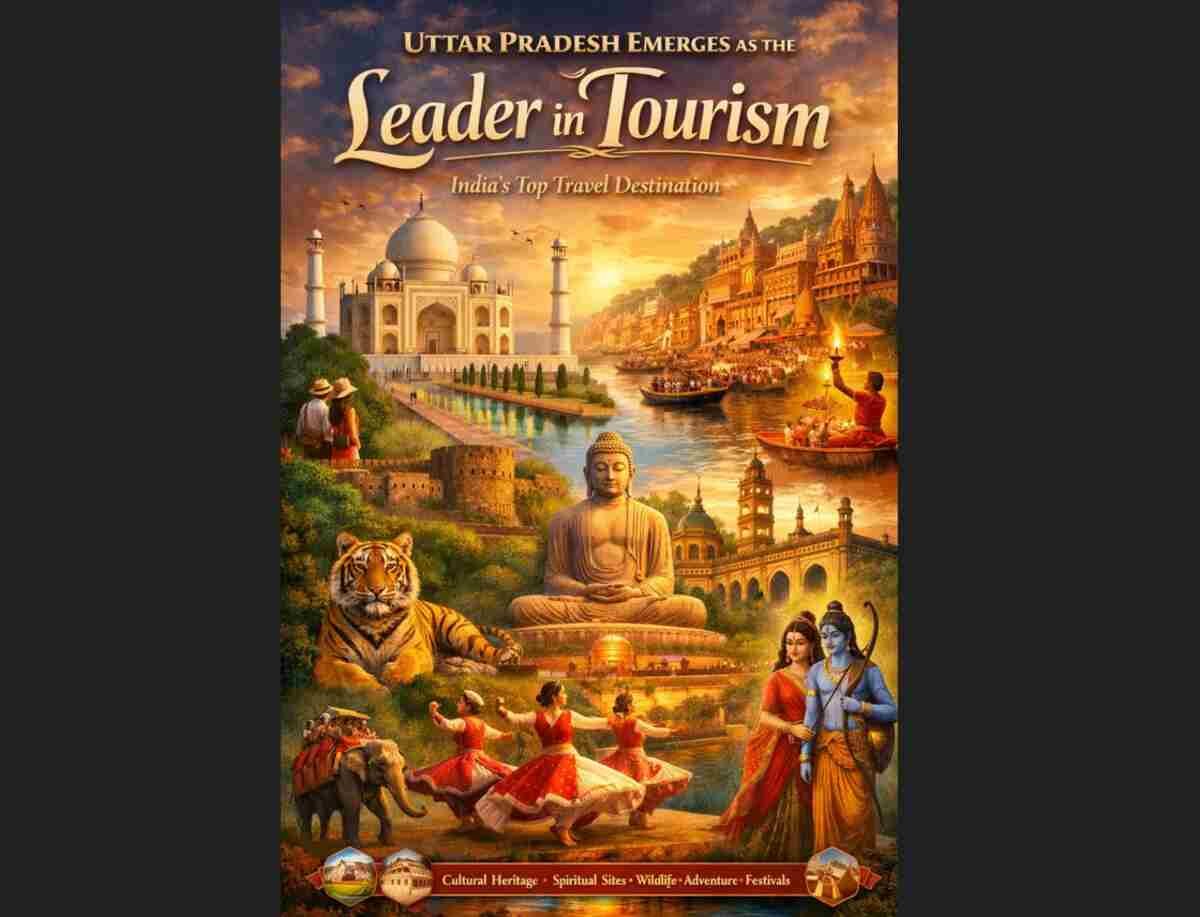
Delhi, March 26: The new success story being written by Uttar Pradesh in the tourism sector is not limited to record-breaking tourist numbers but has become a symbol of a broader cultural renaissance. In the state, faith and economy are complementing each other, giving a new direction to the growth of tourism.
In line with the vision of Chief Minister Yogi Adityanath, the successful implementation of the Tourism Policy 2022, along with the development of eco-tourism, infrastructural improvements in tourism facilities, better connectivity, strong law and order, and expansion of airports, expressways, and transport services, has played a crucial role in boosting tourism.
Additionally, the ‘Temple and Festival Economy’ model of the Yogi government is shaping Uttar Pradesh into a global spiritual tourism hub. A recent study by IIM Lucknow on tourism in Ayodhya has also praised this model.
During the nine-year tenure of the Yogi government, Uttar Pradesh has recorded remarkable progress in tourism, as reflected in the data.
In 2017, the state received around 23.75 crore tourists, which nearly doubled to 54.06 crore in 2019. Although there was a decline during the COVID pandemic, the effective implementation of the Tourism Policy 2022 led to a rapid recovery. As a result, in 2024, with 64.91 crore tourists, Uttar Pradesh became the state with the highest number of domestic tourists in the country and ranked fourth in foreign tourist arrivals.
Furthermore, in 2025, the Mahakumbh-2025 led to an unprecedented surge, with tourist numbers reaching 156.18 crore. Notably, over the past 9 years, tourist footfall in Uttar Pradesh has increased nearly sevenfold. Currently, the state accounts for 21.9 percent of India’s domestic tourism share, indicating its growing prominence as a global tourism hub.
The Uttar Pradesh Tourism Policy 2022, aligned with the Chief Minister’s vision, has brought transformative changes to the tourism-driven economy. The policy promotes 22 activities, including hotels, homestays, eco-tourism, wellness, and adventure tourism, supported by investment-based subsidies.
So far, an investment target of ₹36,681 crore has been achieved, and over 1,684 tourism units have been registered. This has generated more than 5 lakh employment opportunities in the state, with notable growth in women’s participation.
To strengthen religious and cultural tourism, several pilgrimage development councils have been established and revitalized, enhancing facilities for devotees while boosting local tourism economies.
Key initiatives include the Ayodhya, Devipatan, Braj Teerth, Vindhyachal, Chitrakoot, Naimisharanya, and Shuk Teerth Development Councils. Additionally, more than 12 tourist circuits have been developed, including Ramayana, Krishna, Buddhist, Jain, Sufi, and Freedom Struggle circuits. The widening and development of 83 religious routes have further improved accessibility for pilgrims.
Tourism activities have been strengthened through the preservation of the state’s cultural heritage. Notable initiatives include the establishment of Bhatkhande Sanskriti University in Lucknow, museums in Kaushambi and Barabanki (Babu K.D. Singh Museum), the Gorkha Regiment Center, a museum in Meerut dedicated to the 1857 Freedom Struggle, and the Shaheed Memorial in Gorakhpur.
Projects such as Azad Park and the ‘Dekho Prayagraj’ trail, development of Bundelkhand (Mahoba) as a heritage tourism destination, the International Ramayana and Vedic Research Institute in Ayodhya, Buddha Theme Park in Kushinagar, and integrated tourism development in Bateshwar (Agra) and Shravasti are contributing to both cultural enrichment and tourism growth.
To promote eco-tourism, the UP Eco-Tourism Board was established in August 2022. Facilities such as night stays, watch towers, nature trails, cafeterias, homestays, and bird-watching have been developed in major eco-tourism destinations like Dudhwa, Katarniaghat, Pilibhit Tiger Reserve, Amangarh, and Sohagibarwa forest regions.
A total of 49 eco-tourism projects have been initiated, and 234 villages have been selected for rural tourism.
Youth tourism clubs have also been formed across all districts to enhance local participation.
The ‘Temple and Festival Economy’ model has proven to be the most influential factor in tourism growth. A strong example is the consecration ceremony of the Ram Temple in Ayodhya.
Tourist numbers in Ayodhya surged from 2.84 lakh in 2017 to over 16.44 crore in 2024, and further to 29.95 crore in 2025. Similarly, the Kashi Vishwanath Dham Corridor in Varanasi and the Kumbh and Mahakumbh in Prayagraj have significantly boosted tourism in these regions.
This model has extended beyond major cities, with 197 historical and sacred sites restored between 2017 and 2025, leading to substantial growth in tourism-driven trade and employment.
Festivals in Uttar Pradesh have transformed into grand cultural spectacles. Events such as Ayodhya’s Deepotsav, Varanasi’s Dev Deepawali, and the Holi celebrations in Mathura and Barsana attract both domestic and international tourists. The Mahakumbh-2025 in Prayagraj alone witnessed 66.30 crore visitors, breaking global records.
Regional fairs such as Lalitpur’s Lakhri Mela, Bulandshahr’s Kartik Purnima Ganga Snan Mela, Meerut’s Nauchandi Mela, Agra’s Bateshwar Cattle Fair, and Ballia’s Dadri Mela have also been elevated to grand scales, benefiting sectors like hospitality, retail, transport, prasad and floriculture, and services.
This cultural resurgence and expansion of tourism infrastructure are steadily positioning Uttar Pradesh as a global spiritual tourism hub.
The Tourism Policy 2022 and the ‘Temple and Festival Economy’ model have played a pivotal role in this transformation. Over the past 9 years, Uttar Pradesh has surpassed states like Rajasthan, Kerala, and Tamil Nadu to rank first in domestic tourism.
Moreover, the increasing number of international visitors to spiritual centers such as Kashi, Ayodhya, Mathura, and Prayagraj is set to further establish Uttar Pradesh as a leading global destination for spiritual tourism.